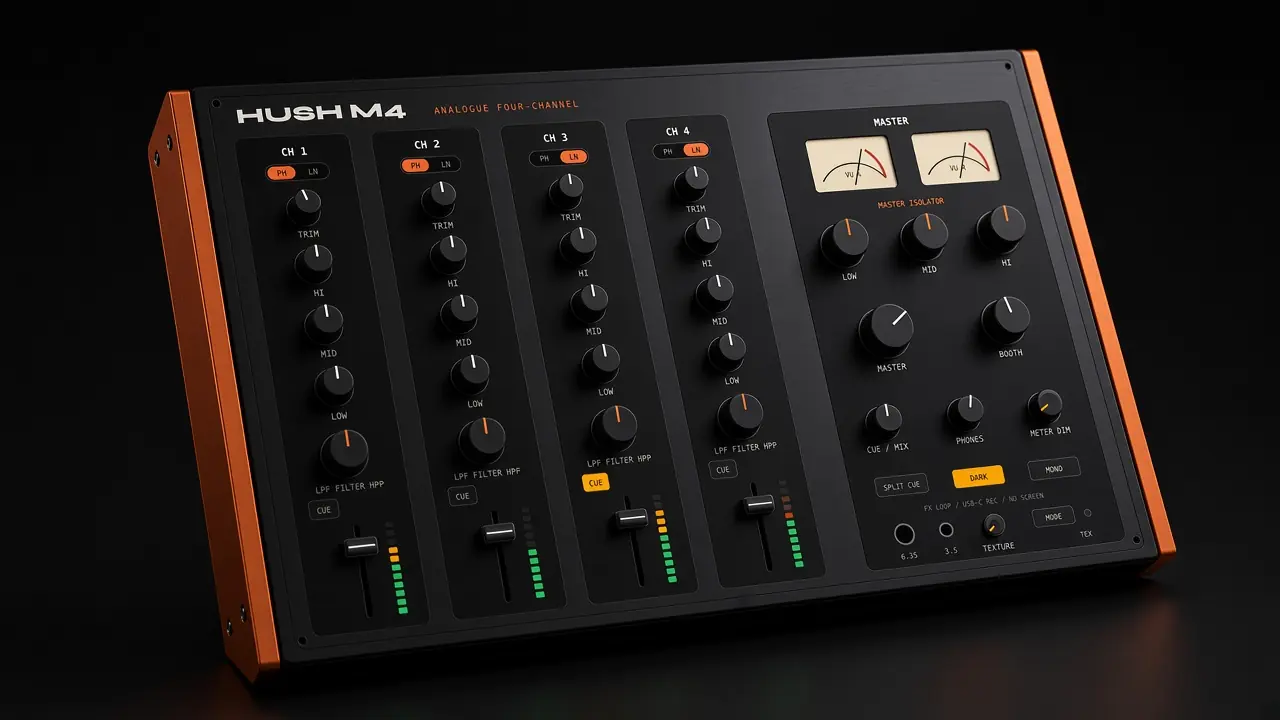
Four identical channels, a four-band EQ on every strip with full kill on the shelves, a filter on every strip and an effects loop that stays out of the signal path until you switch it in. No crossfader, no DJ software, no screen. The brief comes from DVS1’s own published words, quoted and linked below.
HI / HI MID / LO MID / LO4-band EQ: shelves kill to +6 dB, bells +10 / −27 dB; 12:00 is flat
FILTERHigh-pass / low-pass, bypass at centre
CUEPre-fader listen
Fader60 mm, no crossfader
MASTER ISOLATORShapes the whole mix
MASTER / BOOTHBalanced outputs
CUE / MIX, PHONESHeadphones, split cue
MetersVU L / R, dark mode dims them
What it is
Design targets for the finished mixer.
Four identical channels
Each strip switches between phono and line. Four RIAA phono stages, so any deck can go on any channel. Trim ±15 dB.
Four-band EQ on every channel
HI and LO shelves at 3 kHz and 180 Hz go from full kill to +6 dB; HI MID (1.1 kHz) and LO MID (350 Hz) bells go from −27 to +10 dB. Exactly flat at 12:00, on large, widely spaced knobs. Design target.
A clean split filter on every strip
One knob: low-pass counter-clockwise, high-pass clockwise, 12 dB per octave with low resonance. A dead zone at 12 o’clock switches the filter out of the circuit with a relay: true bypass.
An FX loop that stays out of the way
Switchable send and return, hard-bypassed when off. No effect sits in the signal path unless you switch it in.
Master isolator, booth and VU
Shape the whole system. Balanced master and booth outputs, classic VU meters, and a dark mode that dims them.
Headphones
Cue / mix blend and split cue. Both headphone outputs (6.35 mm and 3.5 mm) can run at once, so two people can cue at the same time.
Texture, when you want it
Optional per-strip texture: clean state-variable, ladder, comb or bitcrush, with resonance, drive and an LFO or envelope on the cutoff. Off means nothing in the path.
USB-C record and playback
A design target: a 32-bit float USB-C interface for the four channels plus master. A tap off the analogue path, not part of it. No DJ software, no screen.
Left out
No crossfader, no DJ software, no screens, no menus.
Fully analogue
No converters in the signal path: the USB-C converters sit on a tap. External linear supply.
Gallery
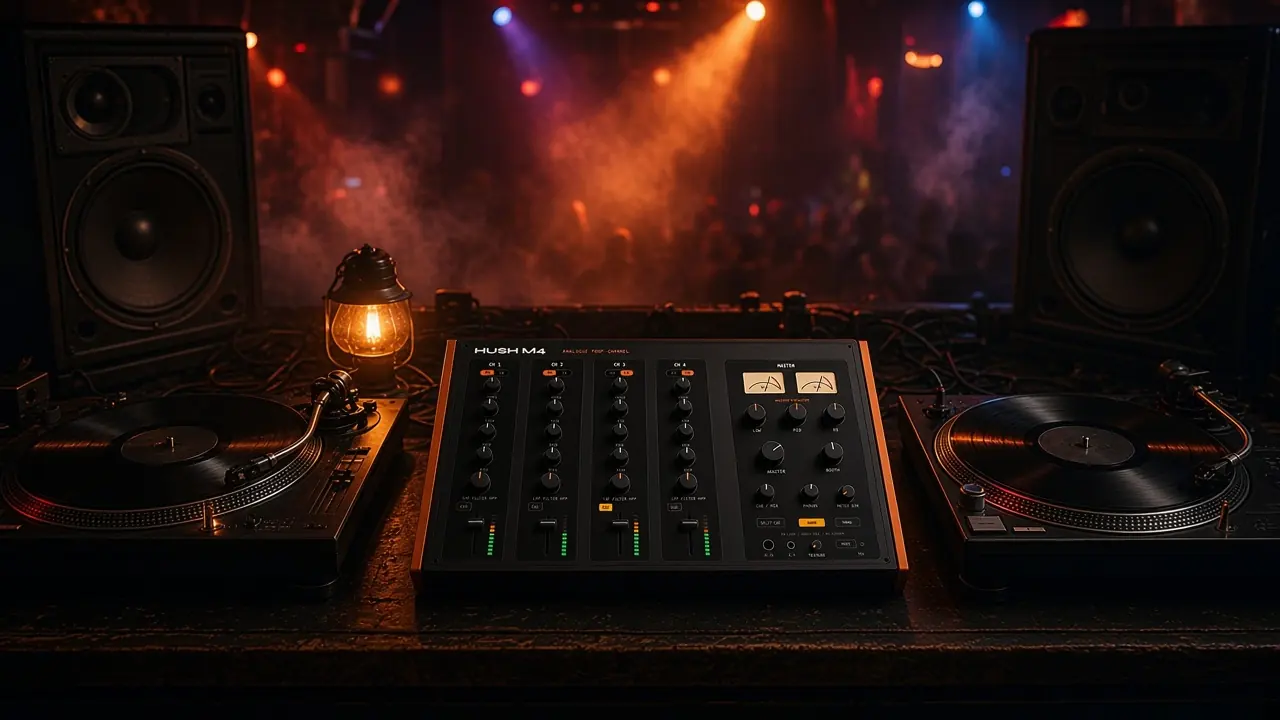
AI-generated illustrations of the intended design. They are not photographs of a built unit.
AI render In a club booth
Play it
Power it on and four generated test signals (kick, hats, bass and chords, 120 to 140 BPM) run through the M4. Ride the levels, kill or boost bands on the four-band channel EQs, sweep the filters, and send the mix through the effects loop: echo, reverb, gate and flanger, or through the spatial FX: tape echo, spring, plate and BBD ensemble. Drag the knobs and faders on the panel itself or use the controls below; double-click a knob to reset it. The meters read the real signal. Everything is synthesised in your browser with the Web Audio API; no samples or recordings are loaded. It is a software model of the intended behaviour, not a recording of the analogue hardware. The model runs in an AudioWorklet where the browser allows it: 32-bit float throughout, a split filter that is exactly bypassed at the centre, optional texture, oversampled soft saturation with internal headroom, and a true-peak limiter on the output only. The hardware design has no limiter in the master or booth path; the model has one so that nothing clips in a browser. You can record the master as a lossless 32-bit float WAV file. 32-bit float is a file format here: it says nothing about the analogue path. You can also load your own lossless files (WAV, AIFF or FLAC) onto the four decks and play them through the same strips and master. They are read in your browser and never uploaded.
Look at it in 3D
A real-time 3D model of the design, drawn in your browser with three.js and WebGL: brushed-metal and anodised materials, studio lighting, no images or models downloaded. Drag to orbit, scroll or pinch to zoom, then turn the knobs and faders; they move the same controls as the panel above, so the sound follows. It is an illustration of the intended design, not a render of a built unit.
The 3D view loads when you ask for it, to save data.
Designed around how DVS1 plays
The brief comes from what DVS1 has said in public: published interviews and his own booking riders. Each row below pairs a feature with his words, word for word and linked to the source. Each source also has a page in the press archive. Rows marked partly documented rest on an inference, and the list underneath says where the design departs from him or where nothing is documented. The interviews are cited as the design brief, not as an endorsement. DVS1 has not reviewed or approved the M4.
Feature
Because he says
The M4 does
Basis
Four identical channels
“Two Pioneer CDJs and two Technics SL-1200 turntables”
No effects in the main signal path unless you switch them in (the FX loop and the optional spatial FX are off and hard-bypassed by default), no screen, no menus, no DJ software. The optional USB-C interface is a tap off the analogue path for recording; it is not in the audio path.
Documented
Built to be worked, not left
“I’m not letting the music play, I’m playing the music.”
Large knobs and 60 mm faders, in the same place on every strip, to be ridden all set. His statements do not mention knob size or spacing; that part is the designer’s inference.
A linear channel fader on each strip. He talks about volume and fader levels; he does not say whether he prefers linear or rotary faders.
Partly documented
EQ to fit a third track in
“Because I have at least two levels going at any time and am looking for a third track to add in, I’m always pushed to manipulate or EQ things to make them fit together.”
“He sometimes ducked a high-mid on the 3s and 4s before bringing it back in for the 1s and 2s, something that the Xone:96 mixer he was using allowed him to do.”
Shelves that go to full kill (and bells that cut 27 dB), so a band can be cleared for the next track. He says he EQs to make tracks fit; how far he cuts is not documented. The second quote is a writer’s account of one show.
Partly documented
Hear the room in the booth
“I need subs, and tops in the booth to really feel that.”
No compressor or limiter anywhere in the master or booth path of the hardware design. (The browser demonstration has an output limiter; see the context list.)
Partly documented
Dark booth
“NO Lights on DJ, Artist prefers to be in the dark”
A PHONES output on 6.35 mm and 3.5 mm, sized for DJ headphones of the kind he names; both outputs can be used together, with split cue. How he cues is not documented, so cue / mix, split cue and the dual outputs are the designer’s choice.
Partly documented
Very long sets
“the ability to spread out and play eight- or 10-hour sets”
External linear supply, no firmware and no boot sequence, user-replaceable faders and pots. His statement is about the length of his sets; these are inferences about what suits them.
Partly documented
Where the design departs, or nothing is documented
FX loop. He says “I don’t need effects” (DJ Times, 2014), yet his own riders ask for stereo cables for an effects box that he brings, on aux 1 (2016 rider, q17). The M4 therefore has an FX send and return, hard-bypassed and off until it is switched in. This departs from the 2014 statement and follows the riders.
USB-C interface. He says “I don’t think a laptop belongs in a DJ booth” (q7). The optional USB-C record / playback interface departs from that: it is a tap for recording, off by default, with no DJ software and no screen, and nothing in his documented setup asks for it.
Spatial FX. He says “I don’t need effects—I don’t need to fluff my mixes” (q4) and his riders ask only for a plain effects send and return that he fills with his own box (q17). DVS1 favours minimal effects, so the M4 spatial FX (tape echo, spring, plate, BBD ensemble) are the designer’s addition, not something he asked for. They are optional, off with the return at zero, and hard-bypassed in hardware by SW3. No source reviewed mentions spring, plate or tape echo.
Four-band channel EQ. He is quoted as saying “I don’t need a 4-band EQ” (q6). The M4 channel EQ has four bands anyway (HI, HI MID, LO MID, LO), which departs from that statement; it was added at the site owner’s request. The only related account is a writer reporting him ducking a high-mid on an Xone:96 (q26). The frequencies and ranges follow the published Xone:96 specification, not anything DVS1 said.
Texture section. No source reviewed mentions resonant, ladder, comb or bitcrush effects, and he says “I don’t need effects” (q4). The texture section is the designer’s addition; it is off by default and exactly bypassed when off.
Four phono stages. The documented setup has two turntables (q1, q2), and the 2019 festival rider lists none. Four phono stages go beyond what he has said he needs; they are there so any deck can use any channel, and could be cut to two to save cost.
Layout. He says he does not like the layout of the Xone mixers and does not say what he dislikes (q3). The M4 strip layout is the designer’s guess. Nothing documented says it is what he wants.
Crossfader. None of the sources reviewed says whether he uses a crossfader. The M4 has none; that is a design choice, not something he asked for.
Rotary or linear faders. No statement about rotary-fader mixers was found. The M4 uses linear faders (see above).
Master isolator and VU meters. No source reviewed mentions either. A writer reports him ducking a high-mid on an Xone:96 (q26); that is the only related account.
Output level and headroom. The +28 dBu maximum output and the ±18 V rails are an engineering choice. He has not said anything about mixer headroom.
Pitch and tempo. He pitches records on Technics MK5G decks (q24). Pitch is on the turntable, so the M4 hardware has no tempo, sync or BPM function. The browser app adds BPM detection, tap tempo, a pitch fader, loops, hot cues and an optional sync as tools of the software model; they are a departure from this, not something he asked for, and sync is off until pressed.
His riders name a mixer. Both riders ask for an Allen & Heath Xone (92, then 96) and say “STRICTLY NO OTHERS” (q30). The M4 would not meet his rider, and nothing here suggests he would use it.
Not found. No usable interview text was found from Resident Advisor, Mixmag or Pioneer on mixer layout, rotary mixers, headphone cueing or booth monitoring. A 2016 Slam Academy video interview exists but was not transcribed, so nothing from it is used.
Context
Browser demonstration. The Web Audio demonstration on this page has an output limiter and soft saturation so that nothing clips in a browser. The hardware design has no compressor or limiter in the master or booth path.
Not applicable. His remark about keeping “a maximum of seven channels” in DJ Mag (2018) is about his studio, not his DJ mixer, and is not used.
Dates. The sources run from 2013 to 2019. His setup has changed over that time (for example Xone 92 to 96, CDJ 2000 to 3000), so these are statements from their date, not today.
Sources
[DT] Jim Tremayne, “DVS1: Back to the Old School”, DJ Times, 5 February 2014 (archived copy) — open
[DM] Rob McCallum, “DVS1: The techno purist rages against the machine”, DJ Mag, 31 January 2018 — open
[LWE] Steve Mizek, “DJ Debriefing: DVS1”, Little White Earbuds, 21 August 2013 (archived copy) — open
[TK] Tobias Fischer, “Interview with DVS1”, Tokafi (undated on the page) — open
[XR] “Ask the Experts: DVS1”, XLR8R, 24 March 2017 — open
[R16] Triangle Agency, artist tech rider, DVS1 – DJ (PDF, 2016 upload) — open
[R19] Triangle Agency, artist festival tech rider, DVS1 (DJ) (PDF, 2019 upload) — open
[MD] “DVS1 Wall of Sound dominates Los Angeles”, Magical Dancefloors. A writer’s account of a show, not DVS1’s words — open
Quotations are word for word from the linked pages (checked by script against the page text). Everything else on this page is the designer’s own wording. They are cited as the design brief, not as an endorsement, and DVS1 has not reviewed or approved the M4.
Quoted in the brief
The design brief on this page uses verbatim lines from these published sources. Each link goes to that source’s existing page in the press archive. No new quotations are added here. DVS1 has not reviewed or approved the M4.
DJ Times · Interview · 5 February 2014 · 10 quotations
DJ Mag · Interview · 31 January 2018 · 3 quotations
4-band: HI shelf 3 kHz and LO shelf 180 Hz, +6 dB to full kill; HI MID 1.1 kHz and LO MID 350 Hz bells, +10 / −27 dB; flat at 12:00
Channel filter
One-knob split filter: LPF counter-clockwise, HPF clockwise, 12 dB per octave, low fixed resonance (Q 0.71); dead zone at centre with relay true bypass
Texture (optional)
Per-strip texture: clean state-variable, ladder, comb, bitcrush; resonance, drive, LFO / envelope on cutoff. Analogue ladder / OTA option and DSP card, both design targets
Faders
60 mm conductive plastic, user-replaceable; no crossfader
Master section
3-band master isolator, master and booth levels, mono switch, VU meters L / R
Audio path
Fully analogue and balanced, op-amp inverting summer; no converters in the signal path
Maximum output
+28 dBu balanced
Frequency response
10 Hz to 40 kHz, ±0.25 dB (line in to master out)
Distortion
THD+N below 0.003% at +4 dBu, 1 kHz
Noise
Signal-to-noise above 105 dB, A-weighted, line in to master out
Crosstalk
Below -95 dB at 1 kHz between channels
Headphones
6.35 mm and 3.5 mm outputs that can be used together; cue / mix blend and split cue
Outputs
Master XLR, booth XLR, record RCA, optional transformer isolation
Power
External linear supply
Effects loop
Switchable send and return with four tempo-locked effects: echo, reverb, gate and flanger; hard-bypassed when off
Spatial FX (optional)
Design target: per-channel sends to a stereo send and return with a mode control. The browser model has four modes (tape echo, spring, plate, BBD ensemble); at return 0 it adds nothing and the hardware switch takes the engine out of circuit. Not built or measured; DVS1 favours minimal effects, so this is the designer’s addition (manual, section C)
USB-C interface (optional)
Design target: record 4 channels plus master and play back, USB Audio Class 2.0, two 4-channel 32-bit ADCs (datasheet dynamic range 122 dB in 4-channel mode); 32-bit float files are produced on the host. A tap off the analogue path
Left out on purpose
DJ software, screens, menus, crossfader
The numbers, and where they come from
Each figure is labelled. Design target is a goal for the finished mixer. Calculated is worked out from a published formula with nominal parts and ideal op-amps; the working is in the manual. No measurements are published yet.
Every stage has a schematic with values and sources on the schematics page and as its own Circuit Atlas page, starting at S1 RIAA.
Technical documents
Circuit Atlas
Schematics
Block diagram and a drawing for each stage: RIAA phono, line input, isolator building block, three-band master isolator, four-band channel EQ, channel filter, VCA fader, FX loop, master, headphone amp, power supply, USB-C interface, texture, spatial FX (design target). Each stage also has its own page.
Terms from the manual and schematics, each linked to its section. Simulation terms are labelled as such. Design targets and calculations, not measurements.
HUSH M4 is in development. The documents above are Rev 2027.4 drafts. Every figure is a design target or a calculation; nothing has been measured yet. There is no price and no ordering. Images marked AI render are generated illustrations of the intended design, not photographs of a built unit.
There is no form, sign-up or contact route for this product, and nothing is stored on this site. No manufacturer schematic or branding was copied.